



Partnerin, Rechtsanwältin, Fachanwältin für Urheber- und Medienrecht
Audiences
Contact
General enquiries
Firm
Contact
General enquiries
Service
Your idea plus our know-how: strong protection for your trade mark.
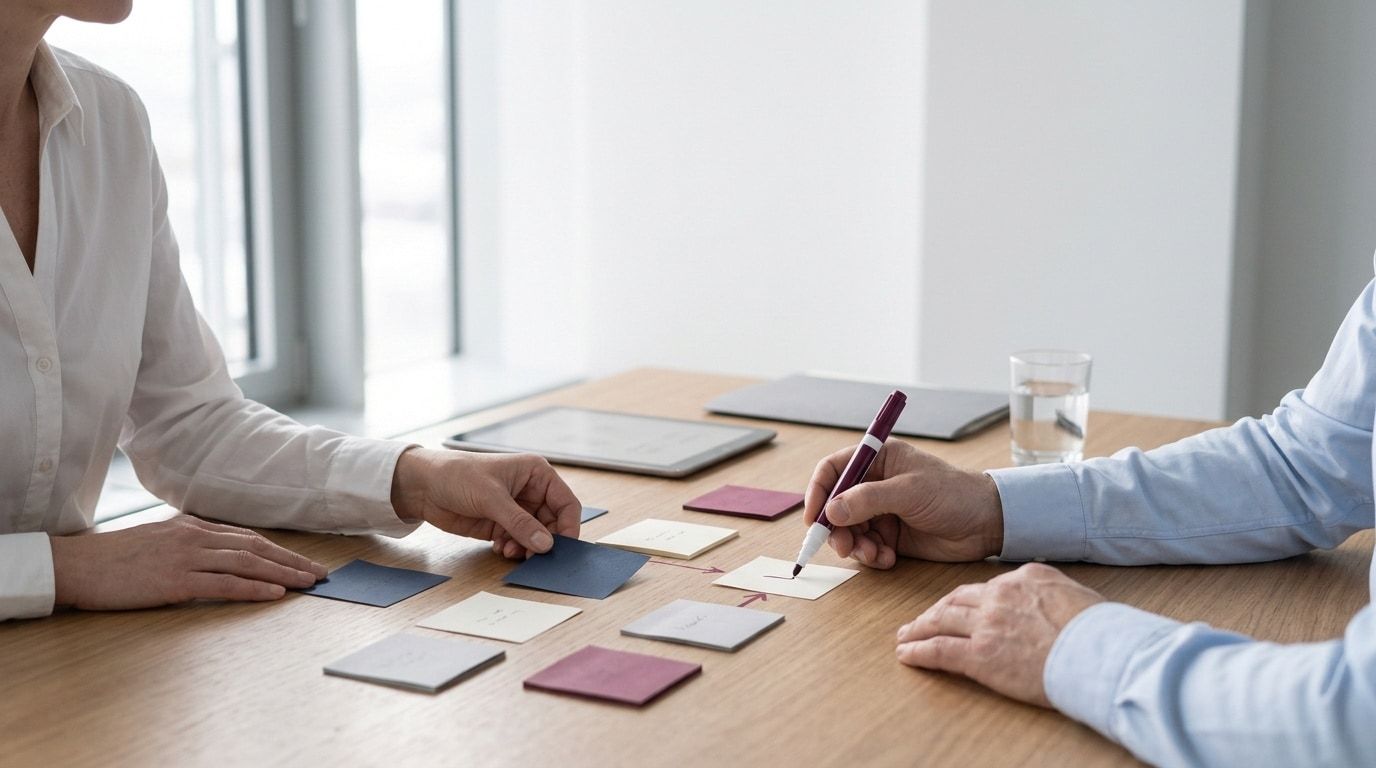
Anyone may register a trade mark. That is why we hold ourselves to this standard: your instruction should bring you added value. More time thanks to our experience. More certainty through expert advice. More value through a trade mark tailored to your needs. And more protection, because we agree on it together with you.
We do not register trade marks in bulk, but made to measure. Your measure. Instead of a ready-made list of goods and services, you receive a list tailored precisely to your needs.
We do not regard our professional advice as an extra, but as a matter of course. After all, this trade mark advice is the very reason you instruct us. A simple application without expert advice is something you could just as well file yourself.
Every trade mark application we file therefore always includes a review of registrability, the recommendation and subsequent joint agreement of a list of goods and services tailored to your plans and, where a trade mark search is carried out, an assessment of the risk posed by possible prior registrations. In short: we are at your side throughout the entire application procedure and are happy to support you beyond it.
Our philosophy: We take seriously the business idea, and often the dream, behind every trade mark, and we look after your trade mark with the same care and dedication as if it were our own.
Orientation
Not every trade mark is a word. Depending on what you want to protect, a different type of trade mark comes into consideration. The overview takes you straight to the relevant section.
Any natural or legal person and any partnership with legal capacity, i.e. companies, associations and others, can be an applicant. Incidentally, this also includes minors, with the corresponding declaration of consent from their parents or guardians.
As the name suggests, a word mark usually consists of one or more words. However, invented sequences of letters, letters with an acute accent, tilde or macron, numbers and special characters are also possible. The German Patent and Trade Mark Office provides an overview of the standard characters under “Schriftzeichen für Wortmarken” (characters for word marks), which opens up a wide range of possibilities. For example, you could also register a word mark such as “Place2b”.
What is then protected is the sequence of words or characters as such, regardless of whether it is used in upper or lower case and in which font or colour.
As a general rule, and especially when registering a word mark: the more creative the coinage, the greater the likelihood of registration and the stronger the trade mark.
Caution is advised when choosing a word mark: signs that are purely descriptive generally cannot be registered as trade marks. If the name directly states which goods or services are offered under it, it usually lacks the necessary distinctive character. In this case, a new, sufficiently original trade mark idea should be developed.
If a sequence of words or characters is to be protected in a particular graphic design and/or in combination with an image, for example a company logo or as part of one, this is done as a so-called word/figurative mark.
There are two reasons for such an application. Out of conviction: a particular graphic design of the word element, or protection of your logo as a whole, matters to you, and both are to be protected. For tactical reasons: if a word mark has descriptive content, adding a figurative element offers a way to obtain registration nonetheless.
If a particular colour is an integral part of the logo and your corporate image, it can make good sense to apply for the word/figurative mark in colour. As a rule, however, an application in black and white is recommended, as this broadens the scope of protection and leaves you, as the trade mark owner, free in your choice of colours.
As the owner of a word/figurative mark registered in black and white, you can therefore also take action against a confusingly similar later trade mark that was applied for in colour. In this case, the colour is irrelevant. If, on the other hand, you own a trade mark in colour, a clearly different colour in the later trade mark can tip the balance and lead to a decision that goes against you.
A figurative mark consists solely of a two-dimensional pictorial representation. With no word element at all. The only exception: non-Latin characters, i.e. Chinese, Cyrillic, Arabic, Hebrew and others. In these cases, the trade mark is in fact registered as a figurative mark.
Apart from words in Latin script, pretty much anything is allowed: pictorial representations, individual letters, symbols or pictograms.
As with the word/figurative mark, this is always a decision to be made case by case. An application in black and white can bring a broader scope of protection and can also make it easier later to show use that maintains your rights. However, if the colour scheme shapes the character and overall impression of your figurative mark, registration in colour is recommended. As so often in trade mark law, there is no one-size-fits-all answer here. The assessments are as individual as the trade marks themselves.
Another type of trade mark is the three-dimensional mark, or 3D mark for short. What is protected here is the three-dimensional shape or design. However, it must not result from the nature of the goods themselves, for example a bag for tennis rackets in the shape of a tennis racket, or be necessary to obtain a technical result.
The shape should also stand out clearly from the existing range of shapes. Successful examples include well-known drinks bottles and chocolate shapes whose appearance departs significantly from the norm and which are still associated with the respective company today. So here, too: creativity wins through.
It is undoubtedly one of the rarer types of trade mark, as it protects exclusively a noise, a sound or a sequence of sounds. It, too, must indicate the commercial origin of the goods or services and must not be technically determined or descriptive.
The sound mark is likely to be of interest now to manufacturers of electric cars, for example, as they can create unique and distinctive sounds and therefore strong trade marks.
At the trade mark offices, “other marks” covers all trade marks that could not yet be categorised at the time of their application. The registers therefore contain various position and motion marks that are now designated as such but did not yet constitute a separate type of trade mark when they were filed.
The so-called tactile mark also falls into this category. It is conceivable in theory, but none has been protected so far. It concerns the sense of touch: a product would have to be made in such a way that merely touching its surface points to a specific manufacturer. An example from nature: anyone who blindly grabs a cactus or a stinging nettle will very probably know what they have just touched.
Taste marks are also conceivable: a truly unique taste that must not, however, be based on its natural properties, but must have been created and must be regarded as unmistakable.
In principle, then, anything we can perceive and attribute to a specific company can be protected as a trade mark. What was still fantasy a few years ago is now reality. And since we do not yet know how things will develop, we can probably expect a few more “other” trade marks in future.
This type of trade mark, too, is one of the exotic ones. It is as rare as it is difficult to register, as the requirements are high: colours should generally remain free for everyone to use. However, some of the best-known colour marks show how helpful good marketing can be in linking a colour so closely to one's own company that merely naming the colour creates a mental connection.
An olfactory mark is a trade mark that consists not of words, images or logos, but of a specific scent. It is intended to enable consumers to recognise the commercial origin of a product solely by its smell.
In practice, olfactory marks are very difficult to register. The scent must be capable of being represented clearly, precisely and objectively so that the scope of protection of the trade mark can be reliably determined. A mere description of the smell or a chemical formula is usually not sufficient for this. In addition, the scent must not be merely functional or customary for the goods concerned.
Whenever a trade mark, i.e. a word, a logo or similar, is always applied in the same place and in the same form and proportions, and this is to be protected, it is advisable to apply for a position mark. Well-known examples are coloured shoe soles, small fabric tabs on the back pockets of jeans and buttons in the ears of soft toys.
Distinctive character plays a particularly important role here, as not only the trade mark itself but above all its positioning must be so specific that the owner can be identified from the position alone.
Suppose you manufacture electrical cables, pipes or hoses, or sell them by the metre, and all these goods have a longitudinal coloured stripe or coloured thread that identifies your goods and links them to your company. Provided there is no older prior registration, you can apply to register this particular identifying feature as a tracer mark and thereby protect your product feature against imitators.
A motion mark protects a specific sequence of movements that consumers can attribute to a company. These are usually short video sequences or animations that serve as a sign of recognition. Although many such sequences of movement are well known, there are so far only a few registered motion marks in Germany.
Whenever a two-dimensional design is to be protected that continues uniformly across a surface in all directions, we speak of a pattern and thus of a pattern mark. Well-known examples come from the fashion and automotive industries. Such an application is also possible for wallpaper patterns. The only important thing is a flat pattern that repeats constantly and in all directions.
A trade mark of our time and of the future. It consists of a moving image and/or three-dimensional elements combined with acoustic elements. In a nutshell: brief presentation videos from all kinds of companies showing their logos and slogans in moving images. We encounter them every day on billboards, as banners on websites and at the beginning of every cinema film.
Holograms seem modern and futuristic, but have long been part of everyday life, for example on banknotes, identity cards and bank and credit cards. As trade marks, however, they have so far rarely been used. Anyone who designs their logo as a hologram and uses it on their products can create a special recognition feature and at the same time break new ground in trade mark protection.
As the only country of protection or as the basic application for an international trade mark. A trade mark registered in Germany protects your product and your service throughout the Federal Republic. Company identifiers, which would otherwise enjoy only regional protection, can also be protected nationwide in this way.
Please note: if you need international protection, a national basic mark must always be applied for first, based on your company's registered office or your place of residence.
Registering a so-called EU trade mark is particularly worthwhile if you plan from the outset to offer your goods and services within the EU beyond Germany. It protects your trade mark in all current and future member states. With a single application, you therefore obtain protection in several countries.
Please note: if a country leaves the EU, the EU trade mark no longer provides protection there. However, the trade mark is usually converted into a national trade mark of the country concerned.
Via WIPO, the international trade mark office, more than a hundred countries of protection can be reached. This requires the prior application for a national basic mark. Internationally registered trade marks can be extended to further countries of protection after registration.
A registered national trade mark is protected in the respective country of protection. Some countries require a registered office or place of residence in the territory for registration; most, however, can be reached without a local presence. Filing by a locally admitted lawyer is almost always mandatory. We have an extensive network of colleagues around the world to obtain the best possible trade mark protection for you there as well.
The German Patent and Trade Mark Office uses the term “goods” as a synonym for “product”. If you have developed a product and want to protect its name, the specific goods must be named in the list of goods, for example shoes, clothing or furniture.
Please note: the list of goods should be as comprehensive as possible. Goods that may come into consideration in future should also be included, as a list of goods cannot be extended afterwards.
Company identifiers in particular are frequently protected for services. These must be specified as precisely and unambiguously as possible in the application, for example financial advice, arranging and conducting lectures or accommodation of guests.
Please note: ideally, all services that are relevant now or may become relevant in future should be specified in the application. If possible future services are not taken into account, a new application may be required later, as the content of a registered trade mark cannot be extended.
Contacts
Partnerin, Rechtsanwältin, Fachanwältin für Urheber- und Medienrecht
Marken- & Designreferentin

Contact
Would you like to make an appointment or arrange a callback or request more information about us?
